
October 2026
Electric Marae Te Whakahiko i ngā Marae
A blueprint for resilience, savings and energy mana motuhake for our marae written by Rewiring Aotearoa alongside Te Pou Take Āhuarangi of the National Iwi Chairs Forum.
Electrifying our marae is a practical, affordable pathway to energy security, mana motuhake, resilience and lower emissions.
Lower bills, cleaner air, and the lights stay on when they really need to.
$6,000 to $23,500
a year off energy bills when a marae swaps its LPG heating, hot water and cooking for electric
- Around 90%lower emissions from those same machines
- Two-thirdsof marae sit in the path of at least one significant natural hazard
- Over 50%of Aotearoa's total energy is imported
The benefits come in five forms
Lower running costs that free up pūtea for our people
Electric machines do the same work on a fraction of the energy, so the savings go back to the marae.
Lower emissions and cleaner air
Switching from gas cuts emissions by around 90% and takes burning gas out of the wharekai, in keeping with our role as kaitiaki.
The lights stay on and the kai keeps cooking
Rooftop solar and a battery keep lighting, refrigeration, cooking and communications running when the grid goes down.
Mana motuhake over our energy
In 2025 around 70% of New Zealand's energy came from fossil fuels, most of it imported. Our energy should be made in the rohe or on the marae roof.
A stronger energy system for all of Aotearoa
Connected marae can export surplus solar, ease local networks and give rural communities power they control.
Modelled on six example marae. Actual costs and savings depend on each marae's energy needs, location and existing infrastructure.
In their words

Kupu takamua | Foreword
Marama Royal MNZM, JP
Electrification offers us a different path, one grounded in tino rangatiratanga.
Read the full foreword
E ngā mana, e ngā reo, e ngā marae maha o te motu, tēnā koutou katoa.
For generations our marae have been the beating heart of our communities. They are where we gather to celebrate, to grieve, to learn, to feed one another, and to uphold the tikanga that define us. They are places of manaakitanga, whanaungatanga and resilience. As our communities grow and the challenges before us become more complex, our marae must be supported to thrive for the generations still to come.
Across Aotearoa, our marae are under growing pressure from rising energy costs, ageing infrastructure and the deepening impacts of climate change. The prices of electricity, LPG, petrol and diesel keep climbing, driven largely by international markets and events far beyond our shores. Every dollar lost to those costs is a dollar our mostly volunteer-led marae cannot invest in our people, our reo, our tikanga and our future.
Electrification offers us a different path, one grounded in tino rangatiratanga. We cannot control global fuel prices or the conflicts of other nations, but we can choose to invest in technologies that draw on the energy gifted to us here in Aotearoa: the light of Tama-nui-te-rā, the winds of Tāwhirimātea, our waters and the warmth of the whenua. By generating, storing and using our own electricity, our marae reduce their dependence on imported fossil fuels, secure their energy supply and build lasting resilience.
The opportunity reaches well beyond lower power bills. Electrification strengthens mana motuhake by giving our marae control over the energy that sustains their daily life. It upholds kaitiakitanga by reducing emissions and caring for Papatūānuku for those who come after us. It deepens manaakitanga by creating warm, healthy and welcoming spaces for whānau and manuhiri alike. And it builds economic strength, lowering operating costs so that scarce resources can be returned to the kaupapa that uplift our people, our language, our culture and our communities.
Above all, electrification strengthens our marae as places of refuge. In every crisis our marae have stepped forward to care for their communities. With renewable energy and battery storage, a marae can keep providing warmth, shelter, kai, communications and support through power cuts and natural disasters, remaining a place of safety and hope when it is needed most.
This report shows that electrification is an investment in the long-term wellbeing of our people. It is an exercise of rangatiratanga over our future: embracing innovation while standing firmly in our values, so that our marae continue to flourish as vibrant centres of culture, connection and community.
Toitū te marae a Tāne, toitū te marae a Tangaroa, toitū te iwi Māori e.
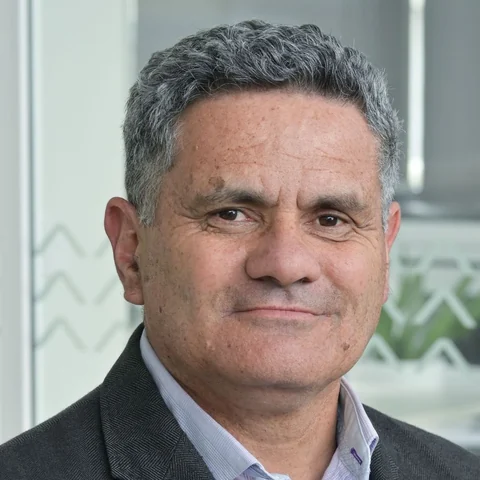
Connection between mātauranga Māori and energy
Dr Will Edwards MNZM
It is Māori being Māori, on our own terms, in a modern world.
Read the full commentary
Mātauranga Māori guides our decision making. When we face the great issues of our time, we look first to whakapapa, to the relationships that bind te ira tangata to our atua. We descend from Ranginui and Papatūānuku, and from their children, whose presence surrounds us in the natural world and in the energy it holds:
- Ranginui, the sky father, who holds the heavens above us
- Papatūānuku, the earth mother, who sustains all life and from whose body come the minerals and materials our technologies are built from
- Tama-nui-te-rā, the sun, whose light and warmth give us solar energy
- Tāwhirimātea, atua of the winds and weather, from whom we draw wind energy
- Tangaroa, atua of the oceans, whose tides and waves hold vast energy
- Parawhenuamea, who embodies the fresh waters that flow from Papatūānuku and fill the rivers and lakes that drive our hydro generation
- Rūaumoko, atua of earthquakes and volcanoes, source of the geothermal heat beneath us
- Mahuika, atua of fire, who gave fire to Māui and through him to us
- Tāne Mahuta, atua of the forests and birds, from whose realm come our wood and biomass
- Tūmatauenga, atua of people and human endeavour, who reminds us that our use of these gifts carries responsibility
Each iwi and hapū holds its own kōrero about these atua, and we honour those differences. Each atua is expressed in our physical world. People and atua, people and te taiao, are bound together in one whakapapa.
Our tūpuna understood that drawing on the elemental forces of wind, sun, water and the heat of the earth is an expression of our relationship with te taiao. We may use these forces for the wellbeing of our people, always with care for the environment that sustains us. Woven through our pūrākau and our whakapapa are reciprocity, respect, humility and awe before the power of nature, and the understanding that we are one strand in a much wider web of relationships. Te taiao sustains us, and we owe it care in return. Ours is a relationship of respect.
Today Aotearoa is beginning to embrace Matariki as a nation, and through it to rediscover the awe of the natural world and our place within the wider cosmos, knowledge our tūpuna always held. Kaitiakitanga and te reo Māori are gaining recognition here and around the world. Now is the time for Aotearoa to view its relationship with energy, with the forces of nature and with our place in the environment through that same lens.
Our marae stand across the length of Aotearoa as places of refuge whenever nature reminds us of its power. They are places of reciprocity and care, where we gather in times of joy and celebration, of debate, of deep sorrow and of mobilisation. Whakahiko i te marae, electrifying our marae, is a pathway for our collectives to secure mana motuhake: authority over our own lives, our own wellbeing and our own spaces in the modern world. It also opens opportunities for commercial benefit within the wider community.
Electrifying our marae is a step towards Māori community energy precincts, where our marae, papakāinga, kōhanga reo and kura, small businesses, and food and fibre producers all draw on shared, locally generated energy. Energy is central to reclaiming our places and spaces: to be Māori, to determine our own futures as Māori, and to live as Māori in contemporary society, in the local economy and in the global economy, on our own terms. Our marae are woven into everyday life. Trade and commerce have always happened on our marae, continue today, and will grow again into the future. Food and fibre industries and other enterprises have long been run, locally and internationally, from our marae, providing products, services and experiences. Our marae have always been sites of tauhokohoko, of exchange and trade, long before the word commercial entered our vocabulary, and they will remain so long after.
Mātauranga Māori is observed, lived and handed down. It grows from generations of relationship with te taiao: with Tāne Mahuta and te ngahere, with Tāwhirimātea, with te moana and te whenua. It is knowing how to draw on them and how to live alongside them, and carrying that knowledge forward as lived experience. Our language, our philosophies, our toi and our kai all grow from that relationship. We are an expression of te taiao, and the closer we hold to that relationship of kinship and care, the stronger we stand. Science asks us to test and prove; mātauranga asks us to watch, to listen, to remember and to stay connected. Electrifying our marae sits where these two ways of knowing meet: the science of solar, wind and geothermal technology guided by a mātauranga that has always placed us within the natural world. Returning to our roots in a contemporary setting is itself a form of tauhokohoko, commercial and monetised yet grounded in kinship and reciprocity. It is Māori being Māori, on our own terms, in a modern world.
What an Electric Marae looks like.
Every fossil fuel machine swapped for an electric one, with solar and a battery where possible. It stays on the grid for peaks, for backup, and to export what it does not use.
A drawn marae dining hall with solar panels covering its roof, a battery and a hot water heat pump on its side wall, and an induction range inside the kitchen. A power pole connects it to the grid. Kaumātua flats and a kōhanga reo building share its solar. An electric van charges in the carpark beside a public fast charger, with an electric farm vehicle, a ride-on mower and battery tools in front.


Make and store
Solar on the wharekai roof
The cheapest energy a marae can get, made on its own roof with no layers of distribution to pay for.
A backup-capable battery
Stores the day's sun. Solar with a backup-capable battery keeps lights, fridges, phones and medical equipment running when the lines come down.
Still on the grid
Draws on the grid for the big days, exports the surplus, and stays there as a backstop.
Heat, hot water and kai
Heat pumps
About three to four times the heat of a gas heater for the same energy.
Hot water heat pump
Replaces the gas califonts. Its insulated tank can heat on midday sun and hold it, a kind of thermal battery.
Induction cooking
Cleaner air in the kitchen. A big commercial range needs three-phase power, so check that first.
Move and mahi
EVs and chargers
Electric vans for the marae, charging for whānau, and room for a public charger for people passing through.
Electric ATV, mower and chainsaw
Quieter, no fumes, and spare batteries instead of jerry cans.
Share
Power shared with papakāinga and kōhanga
Kaumātua flats can draw on the marae's solar. Kōhanga reo run in daylight, five days a week, right when solar is making power.
What six example marae could save.
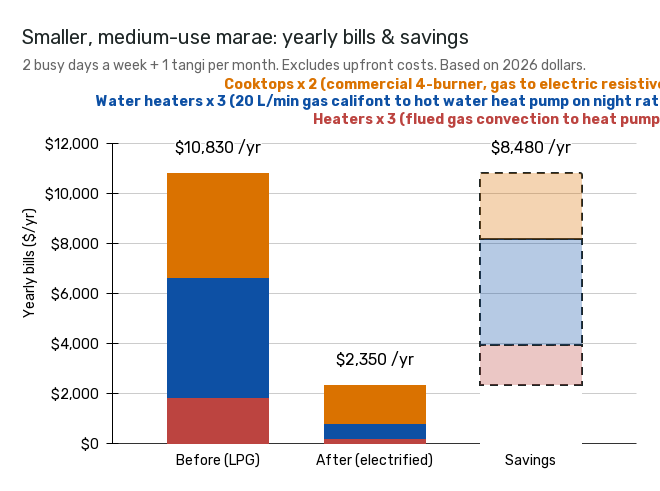
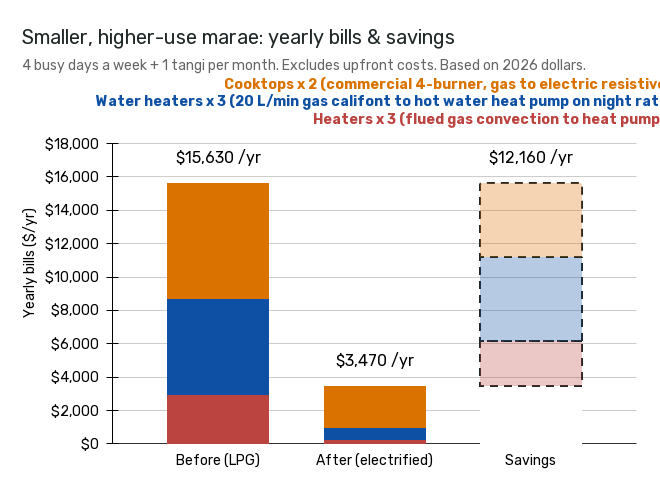
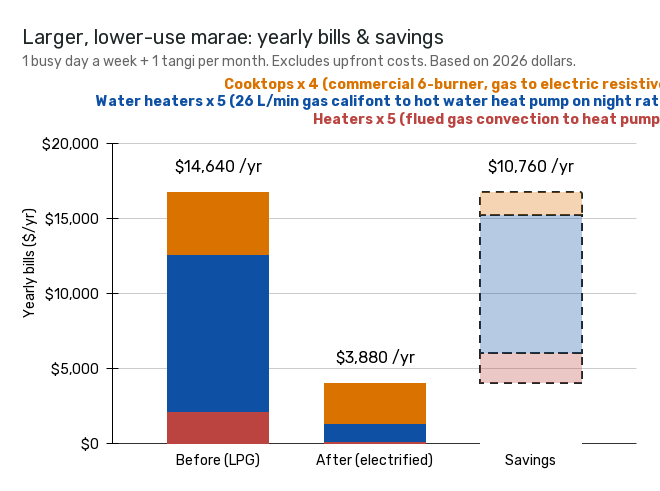
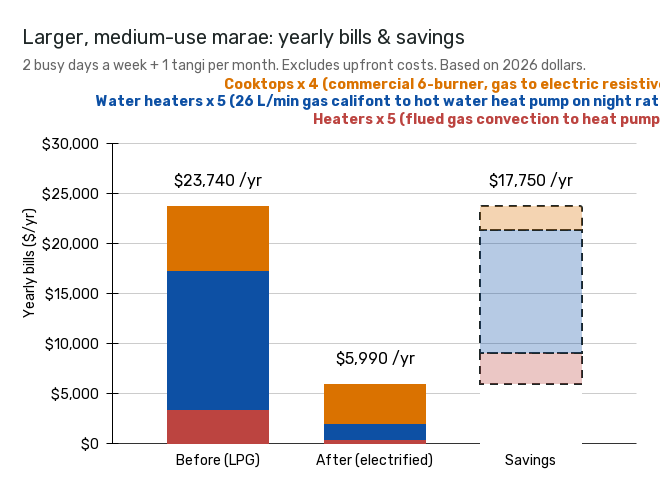
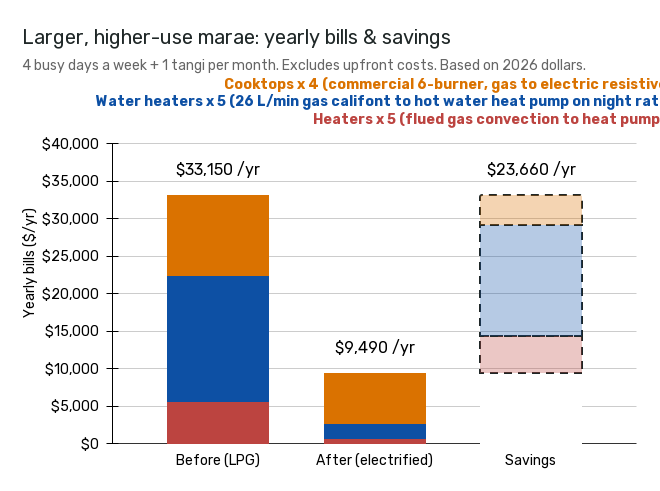
Rewiring Aotearoa modelled six marae, in two sizes and three levels of use, all running on LPG bottles, then switched their heating, hot water and cooking to electric.
| Marae profile | Smaller maraeSingle hapū, often rural, usually with a wharenui, wharekai and ablutions block. Run by hau kāinga, mostly on a volunteer basis, with few or no paid kaimahi. Serves a close, local community, with numbers swelling for tangihanga and large hui. Hot water, cooking and heating are closer to household scale, apart from commercial cooktops in the wharekai.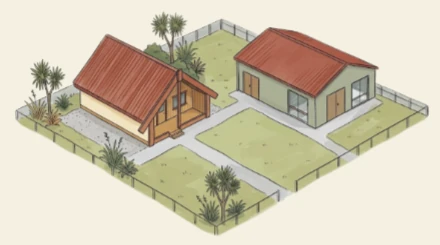 | Larger maraePan-iwi, multiple buildings and services under one roof, from a kōhanga reo, iwi entity office or Whānau Ora services. Often kaimahi are employed for the running and maintenance of the marae. Serves a wide, often scattered community rather than one hapū. Hot water, cooking, and heating are all commercial scale.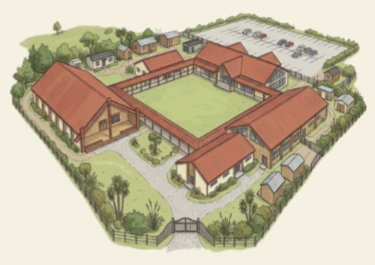 | ||||
|---|---|---|---|---|---|---|
| Lower use | Medium use | Higher use | Lower use | Medium use | Higher use | |
| Indoor area | 132 m² of wharenui, 200 m² of wharekai | 250 m² of wharenui, 400 m² of wharekai | ||||
| Heaters | 1 large flued gas convection heater in the wharenui 2 large flued gas convection heaters in the wharekai | 2 large flued gas convection heaters in the wharenui 3 large flued gas convection heaters in the wharekai | ||||
| How often the marae is occupied | 1 day per week, 8 hours total | 2 days, 1 night per week, 36 hours total | 4 days, 3 nights per week, 84 hours total | 1 day per week, 8 hours total | 2 days, 1 night per week, 36 hours total | 4 days, 3 nights per week, 84 hours total |
| Tangihanga: 3 days a month of 24 hours of heating a day, 72 hours a month in total. | ||||||
| Water heaters | 3 x household-sized instant gas califonts | 5 x larger instant gas califonts | ||||
| Water heating use | 1 day per week of use in the kitchen only | 2 days per week of kitchen use, 1 overnight of showers | 4 days per week of kitchen use, 3 overnights of showers | 1 day per week of use in the kitchen only | 2 days per week of kitchen use, 1 overnight of showers | 4 days per week of kitchen use, 3 overnights of showers |
| Tangihanga: 3 days a month of kitchens on for three meals a day, with ablutions water in use nonstop throughout. | ||||||
| Cooktops | 2 x commercial four-burner hobs | 4 x commercial six-burner hobs | ||||
| Cooktop use | 2 of 4 burners on both hobs at 50% power, 6 hours a day, 1 day a week. | 2 of 4 burners on both hobs at 50% power, 6 hours a day, 2 days a week. | 2 of 4 burners on both hobs at 50% power, 6 hours a day, 4 days a week. | 3 of 6 burners on all 4 hobs at 50% power, 6 hours a day, 1 day a week. | 3 of 6 burners on all 4 hobs at 50% power, 6 hours a day, 2 days a week. | 3 of 6 burners on all 4 hobs at 50% power, 6 hours a day, 4 days a week. |
| Tangihanga: 3 days a month, with 3 of 4 burners (smaller) and 4 of 6 burners (larger) on all cooktops at 50% power, 6 hours a day. | ||||||
Smaller marae
Single hapū, often rural, usually with a wharenui, wharekai and ablutions block. Run by hau kāinga, mostly on a volunteer basis, with few or no paid kaimahi. Serves a close, local community, with numbers swelling for tangihanga and large hui. Hot water, cooking and heating are closer to household scale, apart from commercial cooktops in the wharekai.
- Indoor area
132 m² of wharenui, 200 m² of wharekai
- Heaters
1 large flued gas convection heater in the wharenui
2 large flued gas convection heaters in the wharekai- How often the marae is occupied
- Lower use 1 day per week, 8 hours total
- Medium use 2 days, 1 night per week, 36 hours total
- Higher use 4 days, 3 nights per week, 84 hours total
Tangihanga: 3 days a month of 24 hours of heating a day, 72 hours a month in total.
- Water heaters
3 x household-sized instant gas califonts
- Water heating use
- Lower use 1 day per week of use in the kitchen only
- Medium use 2 days per week of kitchen use, 1 overnight of showers
- Higher use 4 days per week of kitchen use, 3 overnights of showers
Tangihanga: 3 days a month of kitchens on for three meals a day, with ablutions water in use nonstop throughout.
- Cooktops
2 x commercial four-burner hobs
- Cooktop use
- Lower use 2 of 4 burners on both hobs at 50% power, 6 hours a day, 1 day a week.
- Medium use 2 of 4 burners on both hobs at 50% power, 6 hours a day, 2 days a week.
- Higher use 2 of 4 burners on both hobs at 50% power, 6 hours a day, 4 days a week.
Tangihanga: 3 days a month, with 3 of 4 burners (smaller) and 4 of 6 burners (larger) on all cooktops at 50% power, 6 hours a day.
Larger marae
Pan-iwi, multiple buildings and services under one roof, from a kōhanga reo, iwi entity office or Whānau Ora services. Often kaimahi are employed for the running and maintenance of the marae. Serves a wide, often scattered community rather than one hapū. Hot water, cooking, and heating are all commercial scale.
- Indoor area
250 m² of wharenui, 400 m² of wharekai
- Heaters
2 large flued gas convection heaters in the wharenui
3 large flued gas convection heaters in the wharekai- How often the marae is occupied
- Lower use 1 day per week, 8 hours total
- Medium use 2 days, 1 night per week, 36 hours total
- Higher use 4 days, 3 nights per week, 84 hours total
Tangihanga: 3 days a month of 24 hours of heating a day, 72 hours a month in total.
- Water heaters
5 x larger instant gas califonts
- Water heating use
- Lower use 1 day per week of use in the kitchen only
- Medium use 2 days per week of kitchen use, 1 overnight of showers
- Higher use 4 days per week of kitchen use, 3 overnights of showers
Tangihanga: 3 days a month of kitchens on for three meals a day, with ablutions water in use nonstop throughout.
- Cooktops
4 x commercial six-burner hobs
- Cooktop use
- Lower use 3 of 6 burners on all 4 hobs at 50% power, 6 hours a day, 1 day a week.
- Medium use 3 of 6 burners on all 4 hobs at 50% power, 6 hours a day, 2 days a week.
- Higher use 3 of 6 burners on all 4 hobs at 50% power, 6 hours a day, 4 days a week.
Tangihanga: 3 days a month, with 3 of 4 burners (smaller) and 4 of 6 burners (larger) on all cooktops at 50% power, 6 hours a day.
What was switched, and how
- Flued gas heaters to heat pumps
- Gas califonts to hot water heat pumps on night rates
- Gas cooktops to electric resistive cooktops
- One tangihanga a month modelled for each example profile
- Power at 23.7c/kWh for smaller marae and 21.2c/kWh for larger marae
Yearly bills and savings
We have not modelled upfront costs for appliances, because the commercial-scale appliances that most marae use vary significantly in purchase price and installation costs. Therefore, these are bill savings only, not net savings. We do have high-level estimates, both optimistic and pessimistic, to give rough payback periods (Section 2.6.1) which generally indicate that swapping commercial LPG appliances for electric alternatives is an economic choice, assuming standard installs with no complications. Section 1.4.2 talks about optimal electrification design that meets marae energy needs without oversizing connections that drive up infrastructure costs. We do include upfront costs and full lifetime cost comparisons for vehicles in Section 2.7.4 of the report as the models and purchase prices do not vary as much between residential and commercial settings.
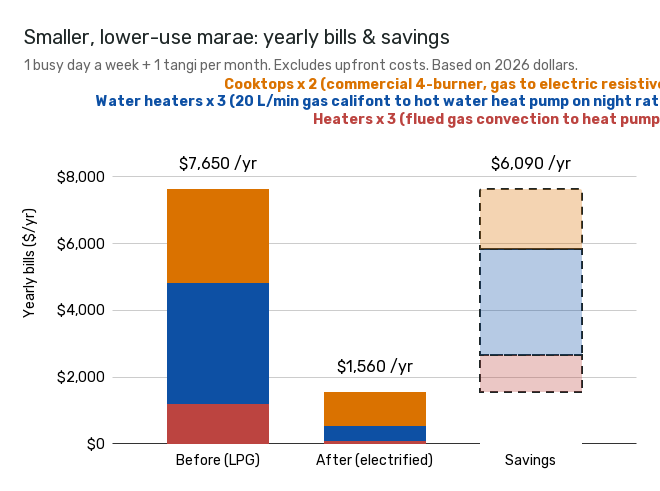 (Open full size)
 (Open full size)
 (Open full size)
 (Open full size)
 (Open full size)
 (Open full size)
Heating, hot water and cooking at 2026 prices, excluding upfront costs. Figures 7 to 12 of the report.
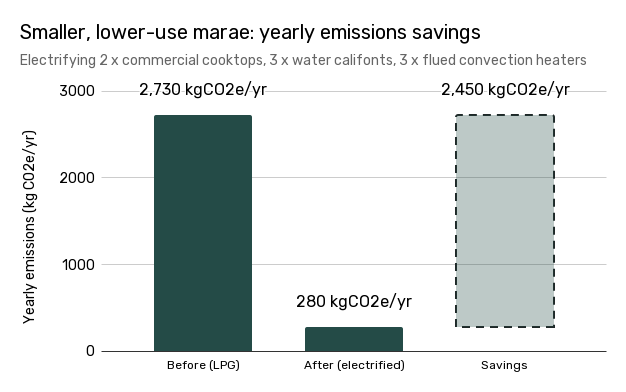
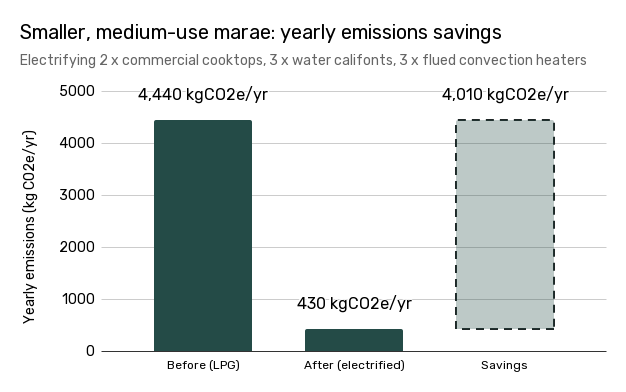
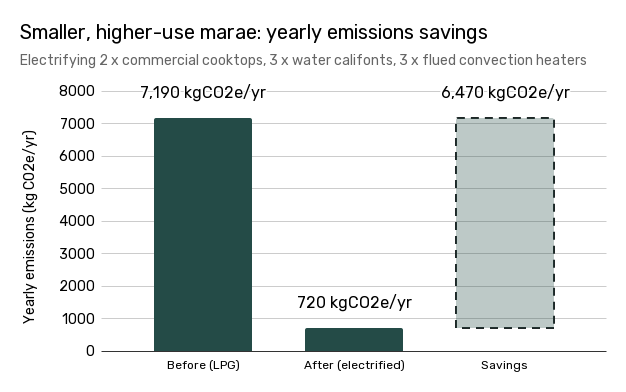
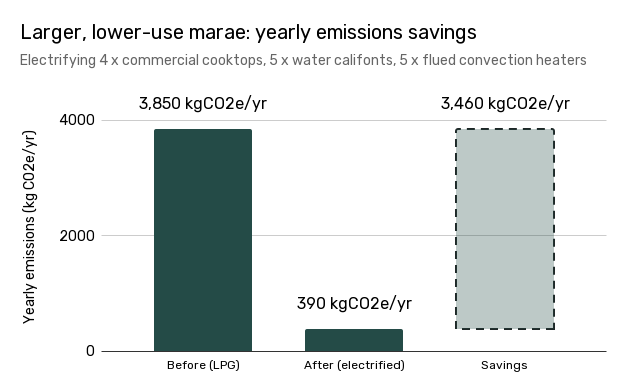
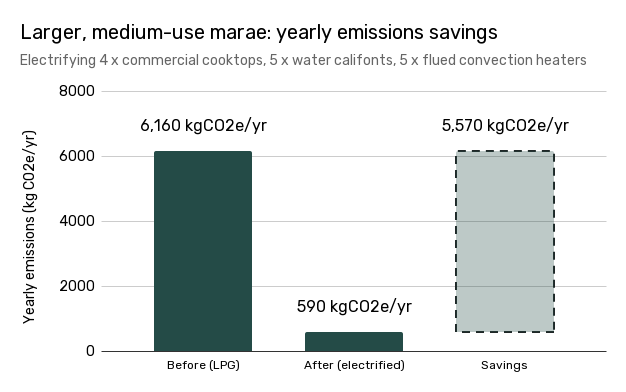
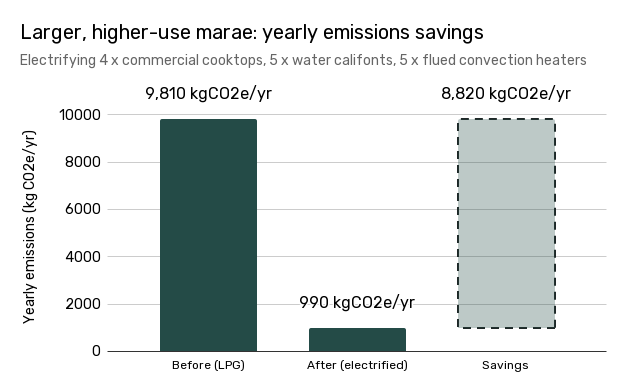
Yearly emissions savings
 (Open full size)
 (Open full size)
 (Open full size)
 (Open full size)
 (Open full size)
 (Open full size)
Emissions from the same machines. Figures 13 to 18 of the report.
The upfront cost, and how fast it comes back
These are high-level estimates to indicate the capex to swapping commercial LPG appliances for electric alternatives, assuming standard installs. Optimising your upgrade is critical to keeping down unnecessarily high fixed grid connection costs, particularly for marae which have spiky energy demands (hui, tangihanga). Learn more in Section 1.4.2 of the report.
Smaller marae
3 heaters, 3 water heaters, 2 commercial four-burner cooktops
- New gas setup
- ~$30k to $35k
- New electric setup
- ~$45k to $75k
$10k to $45k more pays for itself in about 2 to 9 years
Larger marae
5 heaters, 5 water heaters, 4 commercial six-burner cooktops
- New gas setup
- ~$50k to $65k
- New electric setup
- ~$80k to $140k
$15k to $90k more pays for itself in under 1 to under 5 years
Steady for weeks. A few days in fifth gear.
Power bills are built for steady demand. Marae are built for manaakitanga: many are quiet most weeks, then feed and house everyone who comes for a tangihanga. This makes them particularly unique in terms of their energy needs compared to residential houses or commercial buildings.
Most weeks: a fridge and a security light. The fixed charge still lands every day.
Tangihanga: three days in fifth gear. Full kitchen, full ablutions, hot water around the clock.
A single weekend of manaakitanga can set the tariff rate, and the bill, for months.
Good system design can help minimise ongoing charges. In most cases, a well designed solar and battery system combined with a grid connection will still be a lower cost solution for marae to meet these spiky energy demands, even with fixed grid connection charges. Looking forward, it will allow marae to share excess solar generation with the local community and help lower energy bills for whānau directly. Learn more in Section 1.4.
Illustrative shape for the report's modelled assumption of one three-day tangihanga a month, not measured data.
Marae already running on their own sun.
Three marae, three reasons to go solar: a busy kitchen, a seven-day community hub, and a lifeline at the end of one power line.
-
Akaroa, Te Waipounamu
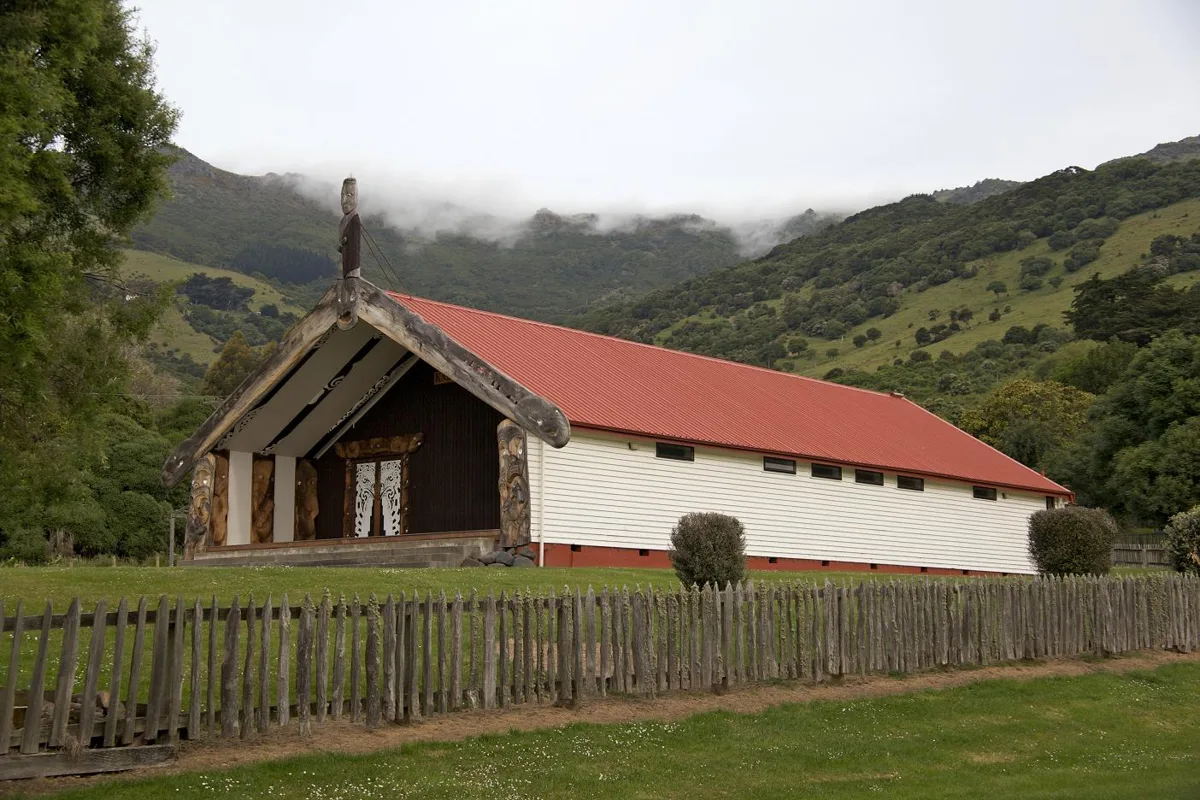
Ōnuku Marae
- 20 kW solar on the wharekai roof (60 panels)
- Heat pumps
- Batteries being installed
Lesson Using your solar-generated electricity during the day before exporting it, or finding other ways to self-consume, is the best way to maximise returns on your solar investment. The addition of batteries builds on that investment to provide greater flexibility and resilience.
-
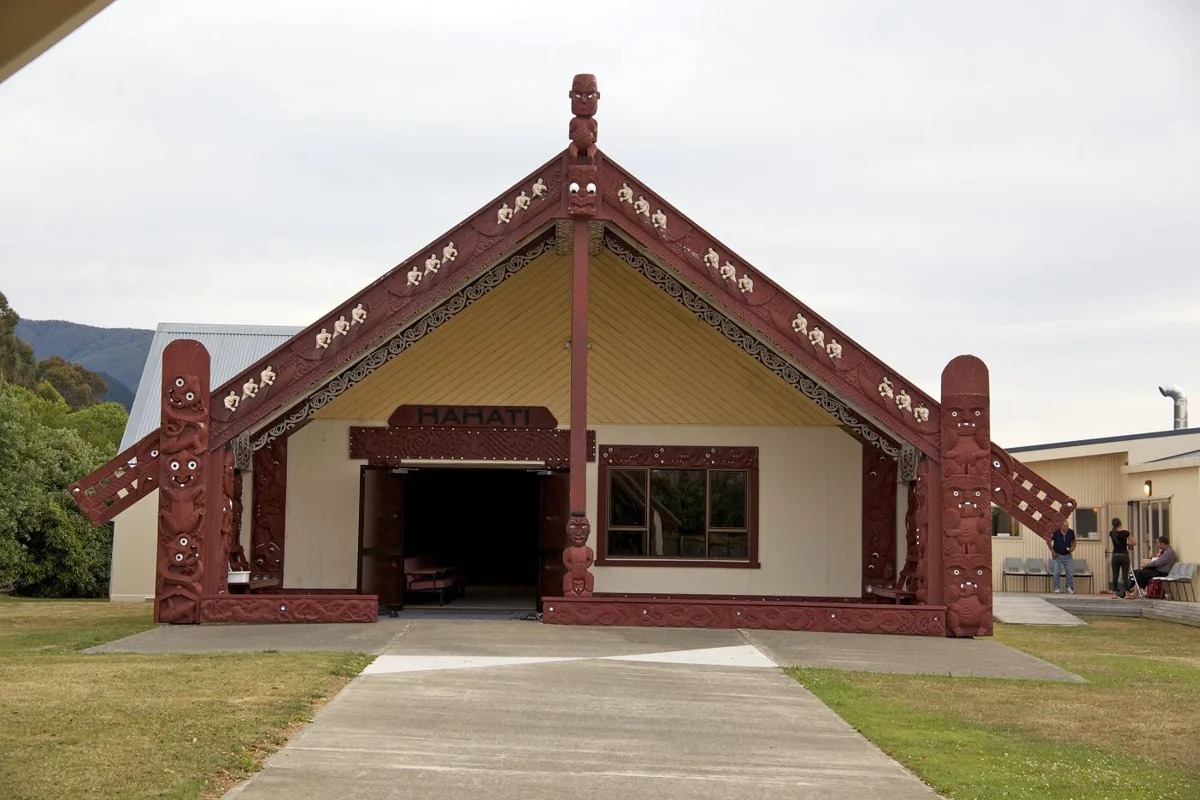
Nelson, Te Tau Ihu
Whakatū Marae
- 14.96 kW solar (34 panels)
- 20.48 kWh battery
- Heat pump; electric water heating
Lesson For a marae that is busy every day, solar plus a battery works hard all year round.
-
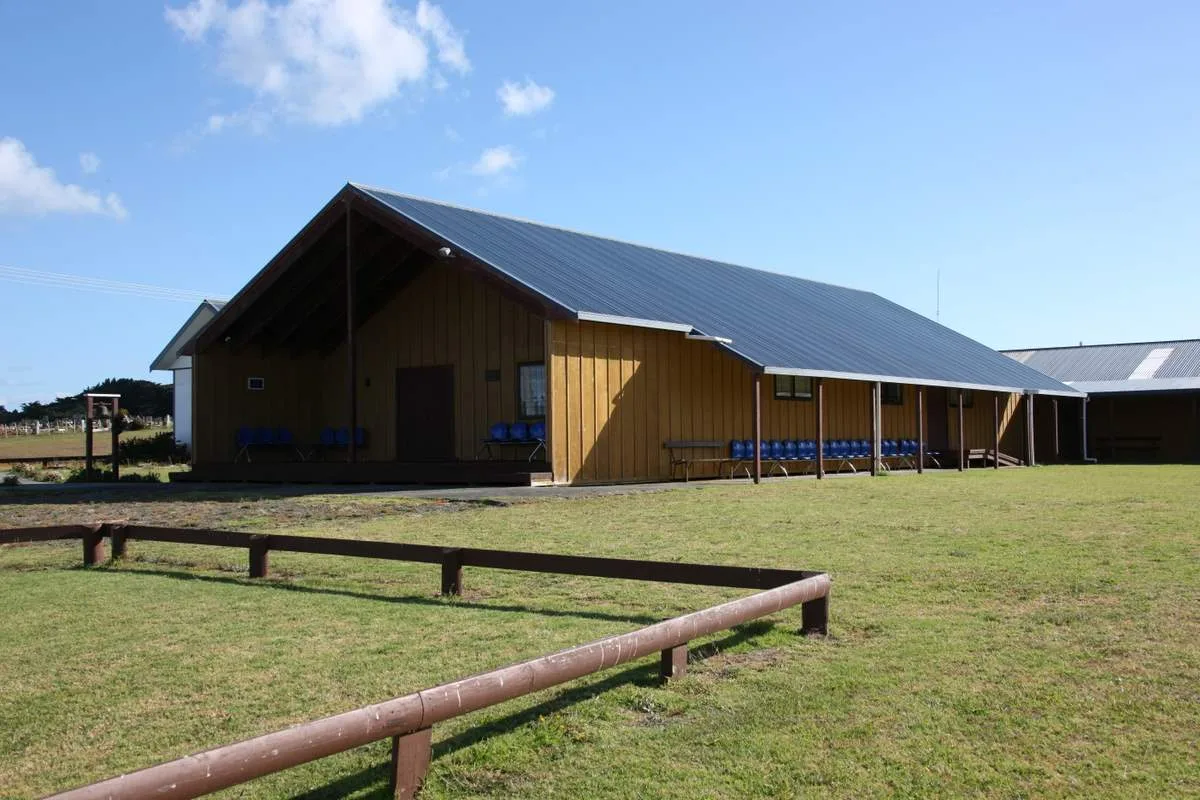
Pouto Peninsula, Te Tai Tokerau
Waikāretu Marae
- 24 kW solar (48 panels)
- Battery with a 45 kVA backup generator
- Heat pump
Lesson For remote marae, solar is about more than money. It can turn the marae into a resilience hub during storms or flooding.
Energy from your own whenua.
All our petrol and diesel and a lot of the LPG that a marae burns comes from overseas. Power made on the marae roof is priced here, not by distant wars or overseas suppliers.
From the other side of the world
$55m a day on fuel that flows straight offshore (Investing in Tomorrow, Rewiring Aotearoa, 2025)
$20b a year roughly, spent at the pump by New Zealand on imported fuel
New Zealand has refined none of its own fuel since the Marsden Point refinery closed in 2022 and we import a lot of our LPG. When a war or a blockade hits supply, a marae feels it within weeks.
From your own roof
A heat pump is 3-4 times more efficient than a gas heater. An EV is 3-4 times more efficient than a petrol or diesel car. The power is cheaper, and it goes further.
What the report asks
and of whom.
Government
Ministers for Energy, Māori Development, Climate Change and Finance; Te Puni Kōkiri; EECA
Keep funding that already works. The Māori Climate Platform helped more than 60 marae install solar and resilience infrastructure, and it is ending. A dedicated marae fund would carry it on.
Fund the machines, not just the roof. Solar on the roof with gas still in the kitchen or heating the water captures only a fraction of the benefit. Funding should cover the electric machines too.
Build on Aotearoa-made energy. A national energy strategy that treats marae as part of the country's energy infrastructure, not consumers at the end of the line.
Regulators
Electricity Authority; Commerce Commission
Pay a fair price for exported solar. A price that reflects the value of clean, local energy.
Let marae share their power. Multiple Trading Relationships and peer-to-peer trading would let a marae choose where its surplus goes, including the homes and papakāinga around it.
Decide for the people who live here. Make decisions in the long-term interest of the communities the energy system serves, marae included.
Emergency management and transport
National Emergency Management Agency and Civil Defence Emergency Management Groups; Minister of Transport; EECA
Recognise marae as resilience partners. Marae already act as community resilience hubs. Policy should value them as such.
Make marae part of the charging network. Support marae to act as electric corridors, hosting EV chargers on land that is already set up for parking and connected.
Iwi and rūnanga
Rūnanga, iwi leadership and marae committees, and iwi with the capacity to invest
Bring the next decision forward. Help marae choose electric each time a machine reaches the end of its life, and sooner where you can.
Help whānau follow. A revolving fund, a bulk buy across the papakāinga, or a dedicated pool for whānau electrification.
Own a stake in the energy system. Invest in renewable generation and in the lines networks that carry power to every marae.
Built to hold everyone.
A marae is where hui and wānanga happen, where milestones are celebrated, and where communities gather to grieve and farewell their dead. It is also where people turn when the river rises or the lines come down.
During Cyclone Gabrielle in 2023, marae across Te Tairāwhiti and Te Matau-a-Māui opened their doors with shelter, kai and care. When floods struck Te Tai Tokerau in January 2026, and Cyclone Vaianu struck the Bay of Plenty in April, they did it again.
As states of emergency are declared across regions, marae open their doors, mobilising faster than centralised agencies and without waiting to be asked.
Te Whakahiko i ngā Marae report
Many marae are both the place their community shelters and a place in harm's way. With solar and a backup-capable battery, a marae can keep the wharekai cooking when the lines come down.
Download the report.
Te Whakahiko i ngā Marae is out now. Leave your email to download the full report.
Thanks. Your copy is ready.
Download the PDF (12 MB)
Written with Te Pou Take Āhuarangi of the National Iwi Chairs Forum
Te Whakahiko i Ngā Marae | Electric Marae was written by Rewiring Aotearoa and Te Pou Take Āhuarangi of the National Iwi Chairs Forum.
Our thanks to the wider steering rōpū who gave strategic direction, kaupapa Māori guidance and accountability. It is built on the energy data, bills and experiences that marae communities across Aotearoa shared.
Our thanks to the National Iwi Chairs Forum and the Electrification Iwi Leaders Group.
Steering Rōpū
- Hinerangi Pere
- Jaydan Salzke
- Juliet Tainui-Hernandez
- Kiritapu Allan
- Levi Walford
- Matiu Taurau
- Matt Newman
- Mel Wright
- Michael Jamieson
- Michael Rewi
- Richard Jones
- Will Edwards